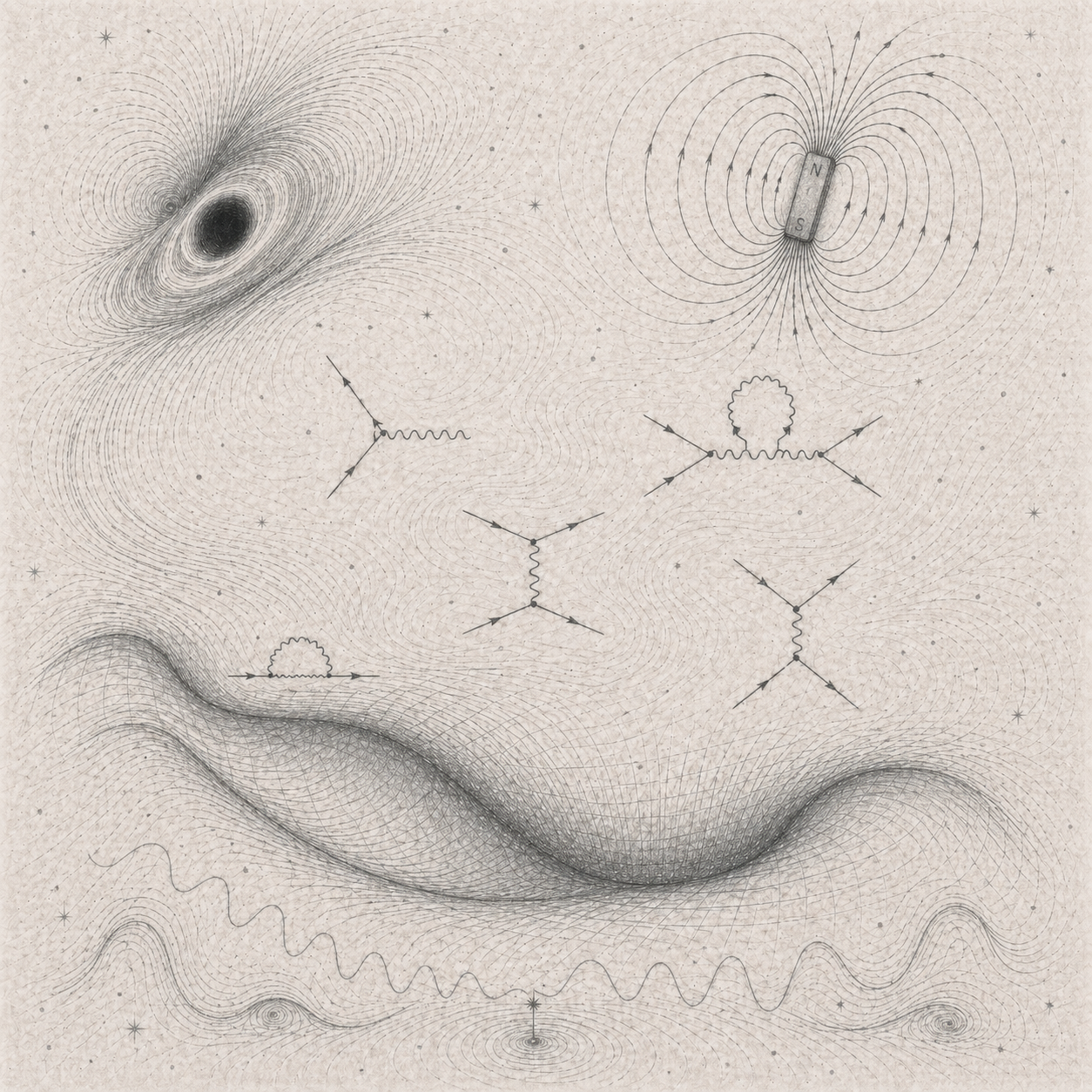
I work on a subject called quantum field theory. Below is a brief description of what that means, together with a number of projects that I've been involved in.
Quantum field theory is the language in which modern physics is written. It's what you get when you insist that forces in quantum mechanics act only locally. It provides the mathematical framework in which to describe the creation and destruction of hordes of particles as they pop in and out of their ethereal existence and interact.
Whether you want to understand the ultimate building blocks of nature, how teams of electrons co-operate inside solids, or how black holes evaporate, you need to work with quantum field theory. Moreover, it has also proven to be a remarkably subtle and rich subject for mathematicians, providing insights into many new areas of mathematics.
You can download all my papers from my publications page.
Over the years, I've applied ideas from quantum field theory to a number of different topics, including particle physics, gravity, string theory, cosmology, condensed matter physics and geometry. Here's a description of some of my favourite projects.
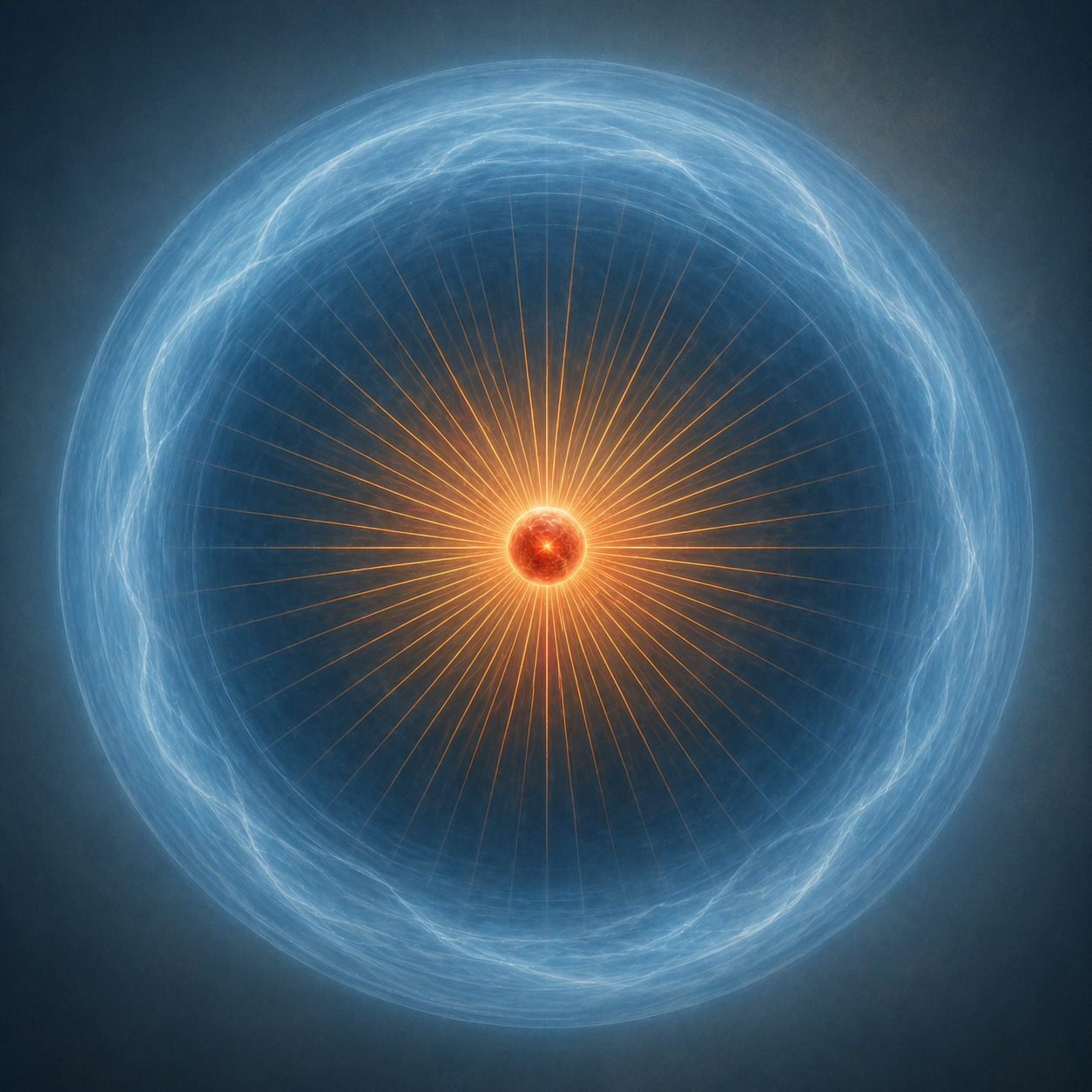
Magnetic monopoles are hypothetical particles. They are, as the name suggests, like a magnet but with just a single pole -- say the north pole with no southern counterpart. They've never been observed, but they're predicted by many theories of physics which go beyond the Standard Model.
The laws of physics are chiral, meaning they don't look the same when reflected in a mirror. Dig into the maths and you find that this is difficult to reconcile with magnetic monopoles. Throw, say, an electron at a monopole and, according to the Standard Model, there's nothing that can bounce back. That's weird! I was obsessed with this puzzle for years, but with Marieke Van Beest, Diego Delmastro and Zohar Komargodski at Stony Brook, and my student Philip Boyle Smith, we found the answer: what bounces back is something novel and unexpected, living in a twisted sector of the Hilbert space. There is still much ongoing work to get a better understanding of the implications of this.
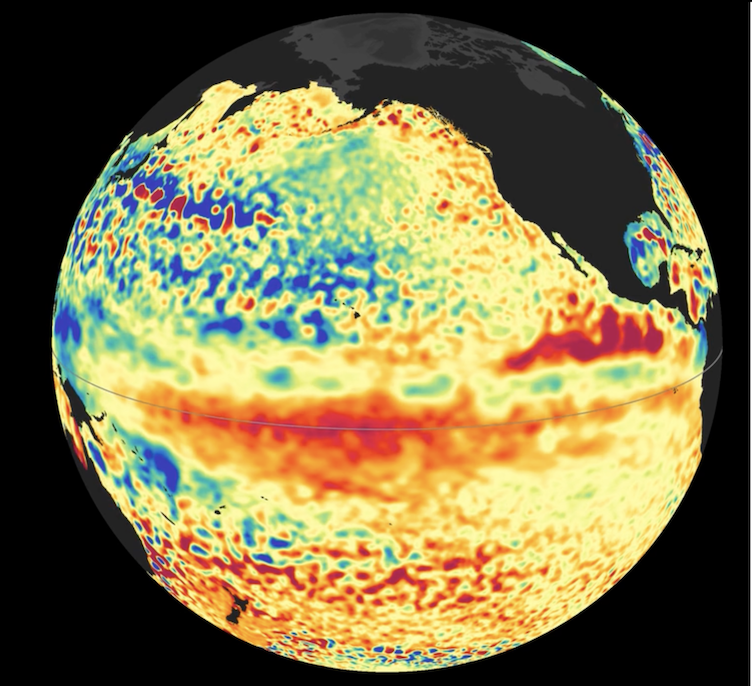
Ocean waves have edge modes -- a particular kind of wave that clings to the coast. Interestingly these edge modes propagate only in one direction -- clockwise, with the land on their right, in the Northern hemisphere, and anti-clockwise, with the land on their left, in the Southern hemisphere.
Similar behaviour is seen in exotic quantum materials, like fractional quantum Hall states and topological insulators, but where the direction of propagation is determined by something like a magnetic field. Some years ago, it was suggested that there's a surprising connection between ocean waves and these quantum solids. I showed that this connection runs deeper, and it's possible to rewrite the equations of ocean waves (the so-called shallow water equations) in terms of the equations of topological states of matter, notably Chern-Simons theory.
The broader story of topological waves in fluid mechanics was told in this Quanta magazine article.

Sometimes, two very different looking quantum field theories actually describe the same underlying physics. This is a phenomenon known as duality. Although well established in supersymmetric theories, it is much harder to demonstrate dualities without the crutch of supersymmetry. In work with Andreas Karch, we found evidence for a web of dualities in d=2+1 dimensions.
This work was motivated by a wonderfully diverse collection of ideas coming from high energy physics and condensed matter physics, including supersymmetric dualities, higher spin theories, the half-filled Landau level, and interacting topological insulators.
This work was highlighted in this Physics article.
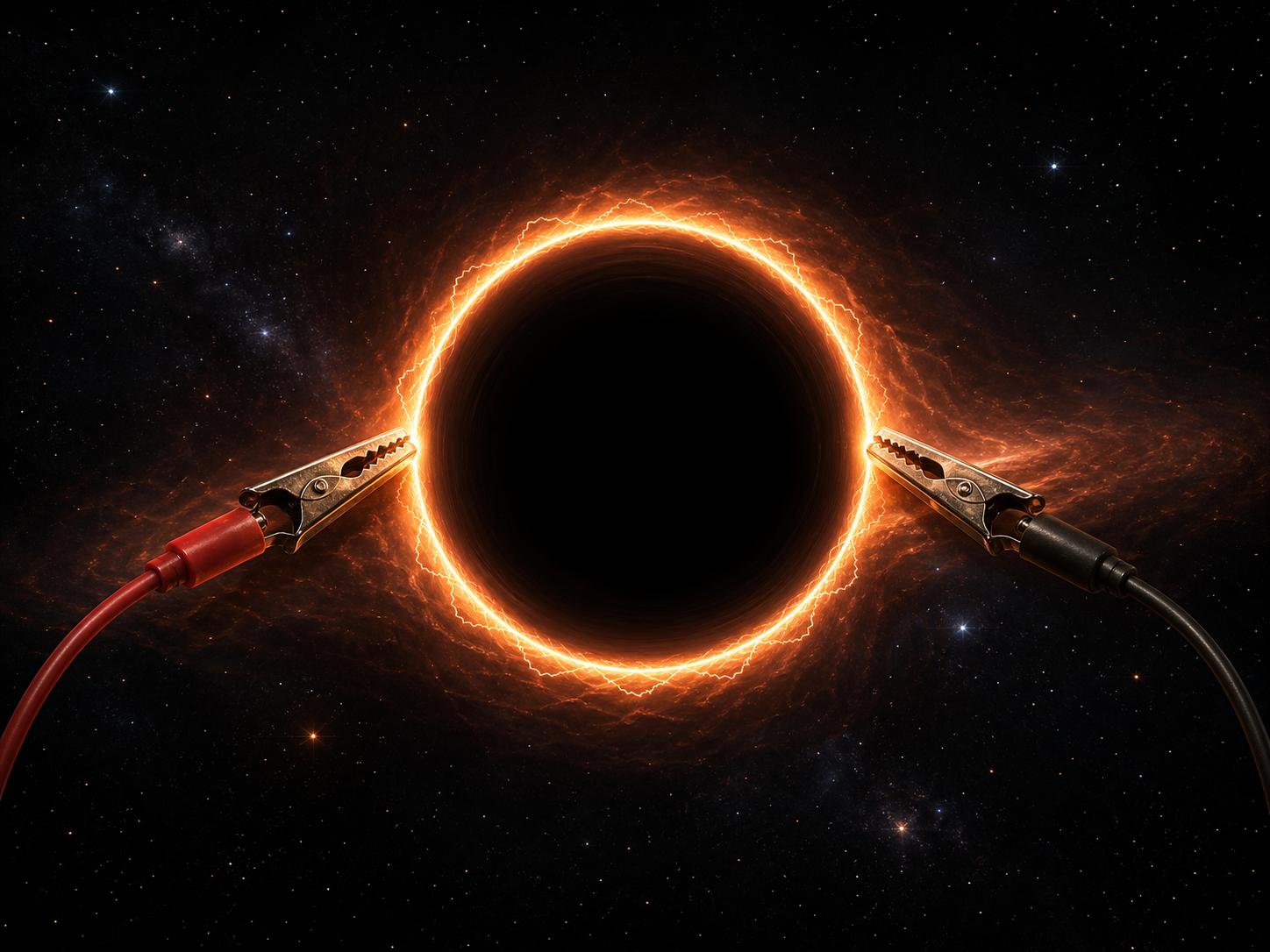
Black holes are objects in which gravity is so strong that nothing, not even light, can escape. There is much that we don't understand about black holes. In recent years, there has been a lot of progress in extracting some of their properties using a framework known as gauge-gravity duality.
In papers with Sean Hartnoll, Joe Polchinski, and Eva Silverstein, and later with Gary Horowitz and Jorge Santos, we studied how the horizons of black holes conduct electricity. There are some surprising similarities between black holes and a mysterious class of materials called strange metals and we hope that this work will ultimately teach us about both black holes and strange metals.
This work was highlighted in this Quanta magazine article.
Quantum field theory and string theory offer a way to generalise basic mathematical ideas of geometry and topology so that space becomes blurry at small distance scales. This has resulted in a number of dramatic new developments in mathematics, prominent among them the idea of mirror symmetry which relates the properties of very different looking spaces known as manifolds.
In a paper with Kentaro Hori, we showed how to solve a class of quantum field theories to give "physics proofs" of a number of conjectures in the mathematics literature. The field theories we solved were non-Abelian gauge theories in two spacetime dimensions and are related to non-toric Calabi-Yau manifolds.
Mathematically, solitons are solutions to tricky non-linear equations. Physically, solitons are new objects that appear in a system due to the cooperative behaviour of the underlying constituents. A familiar example is the vortex that forms every time you flush the toilet or pull the plug in the sink. The vortex appears as an empty region around which the water molecules swirl.
In a zen-like manouevre, physicists consider the absence of water in the vortex as a new object in its own right and study its properties.
I've written many papers on the properties of different solitons, including monopoles, vortices, instantons and domain walls. Usually my interest lies in their quantum interactions. In particular, Ami Hanany and I discovered a new kind of vortex in Yang-Mills theories (the theories which underlie much of particle physics). The dynamics of these vortices provides a new window into questions in quantum field theory.
I made a short video on vortices which can be viewed here.
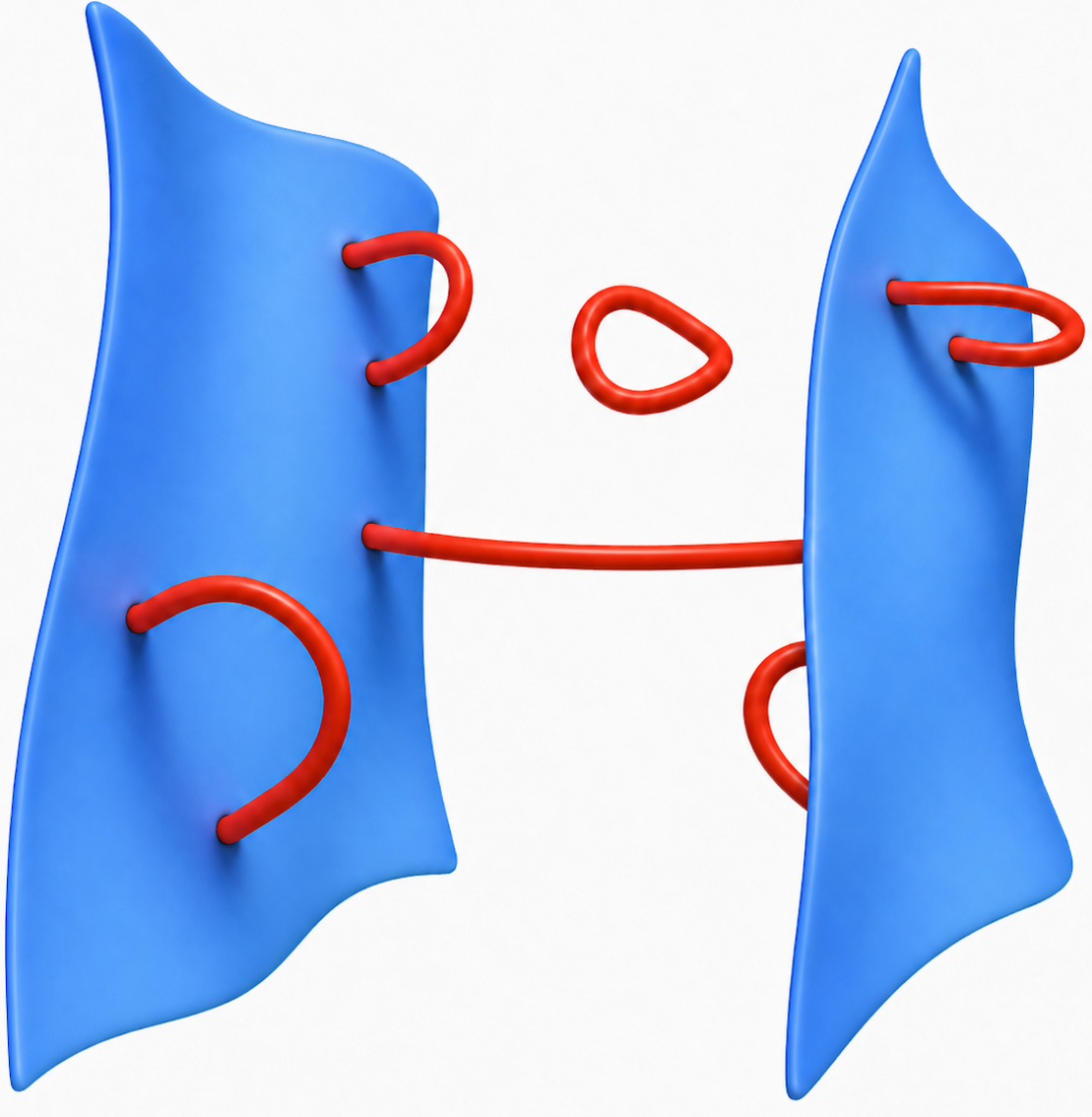
String theory is a framework which combines quantum mechanics and gravity. It offers our best hope to unify all the forces of nature.
String theory also provides new and surprising perspectives on quantum field theory. You could think of string theory as a subset of quantum field theory. One rather lovely fact is that, with a change of perspective, you can also think of quantum field theory as a subset of string theory! Most of my work on the subject has used string theory as a tool, rather than thinking of it as the underlying theory of our world.
I have also written a number of papers exploring the structure of string theory, including a proof of the duality between branes and geometry.
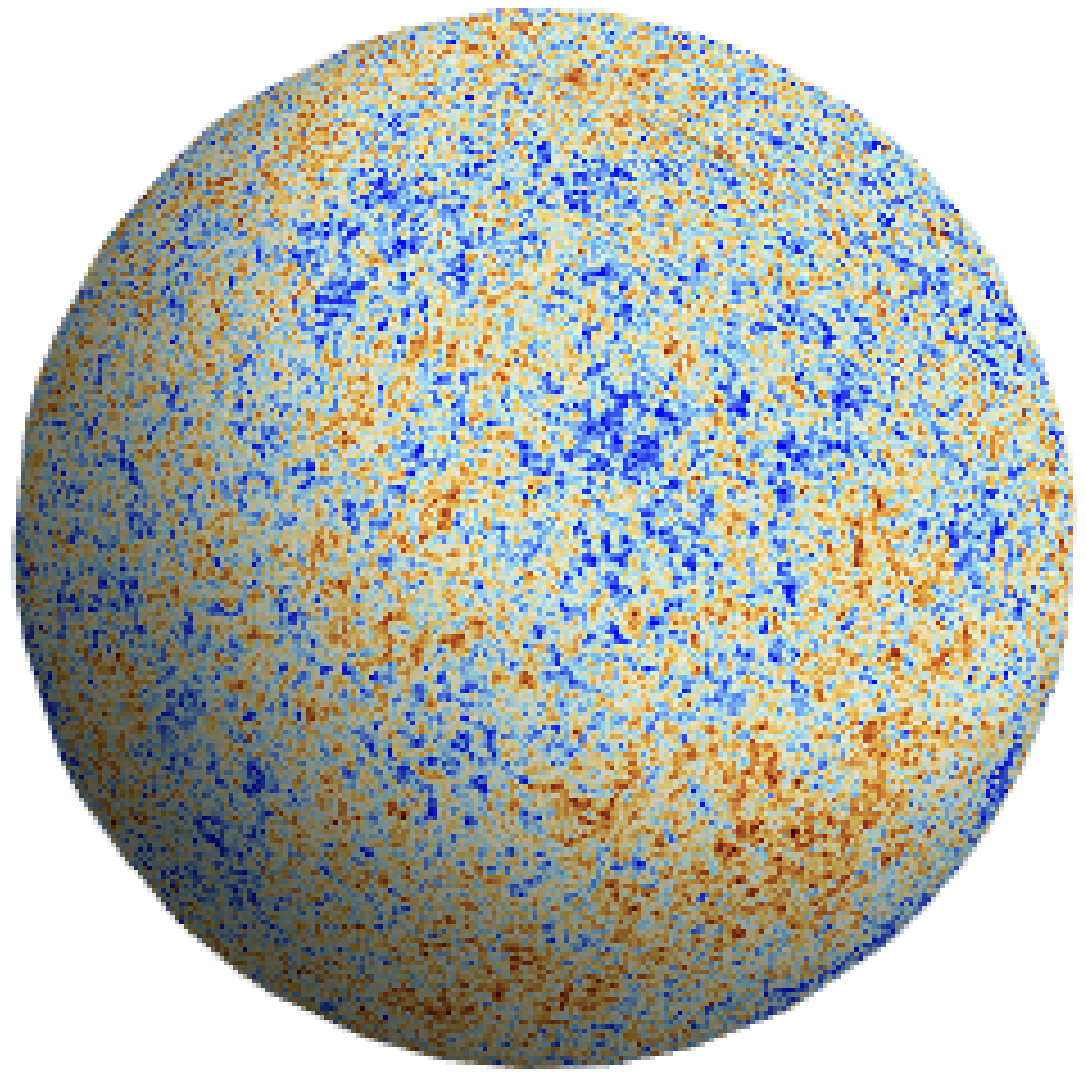
There is strong evidence to suggest that in the first few fractions of a second after the big bang the Universe underwent a very rapid period of expansion, known as inflation.
Together with Eva Silverstein and Mohsen Alishahia, we suggested a mechanism underlying inflation which arises from string theory and extra dimensions. This is now known as DBI inflation. Importantly, this process predicts a distinctive pattern for the ripples in the fireball left over by the big bang. So far, there's no sign of our predicted signal in the data. Perhaps we need finer measurements, or perhaps this process simply didn't happen.
But the fact that it's possible to generate such signatures at all has resulted in a great deal of excitement among both theoretical and observational cosmologists. If such a signal is found, we would be able to push back our understanding of the Universe to much earlier times.