Cosmology
This is a course on cosmology, aimed at final year undergraduate students. It assumes a background in neither general relativity nor statistical mechanics. The full lecture notes come in around 170 pages. Please do email me if you find any typos or mistakes.
These lecture notes can also be viewed in HTML format which may be more accessible for screen readers.
The Expanding Universe
The cosmological principle: homogeneity and isotropy. The geometry of spacetime and the FRW metric. Redshift. Luminosity distance. The Big Bang and cosmological horizons. Perfect fluids and the continuity equation. The Friedmann equation. Simple cosmological solutions, including matter, radiation and dark energy dominated universes. Open and closed universes. The cosmological constant. The energy budget today. Evidence for dark matter and dark energy. The flatness and horizon problems. Inflation.
The Hot Universe
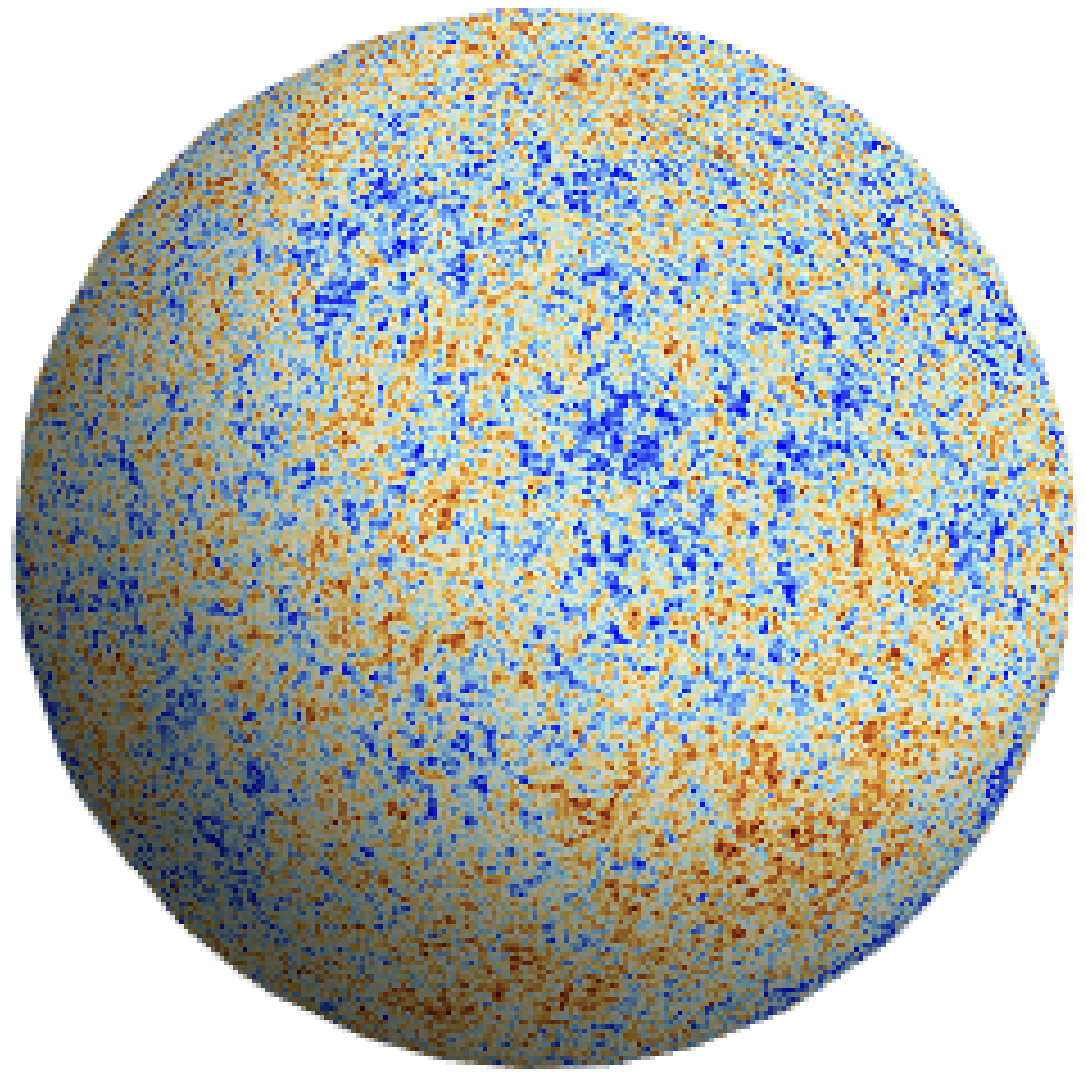
An introduction to the Boltzmann distribution and the Maxwell-Boltzmann distribution for the ideal gas. The blackbody spectrum and the cosmic microwave background. Chemical potentials and the Bose-Einstein and Fermi-Dirac distributions. The Saha equation. Recombination and last scattering. The hot Big Bang and the radiation dominated era. Nucleosynthesis.
Structure Formation
Density perturbations; sounds waves, the Jeans' instability and perturbations in an expanding space. The transfer function. The power spectrum. Baryon acoustic oscillations. Window functions and the mass distribution. The CMB. The Sachs-Wolfe effect. A brief introduction to CMB physics. Non-linear perturbations; spherical collapse, virialisation and dark matter halos, an anthropic explanation of the cosmological constant. Inflationary perturbations and the Harrison-Zel'dovich spectrum.